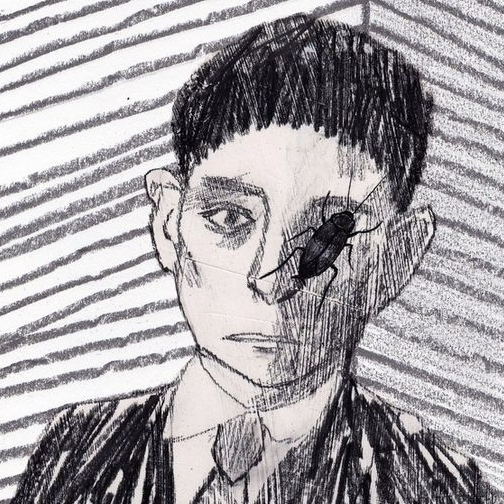
The Metamorphosis by Franz Kafka is a novella that tells the tale of Gregor Samsa, a man who is transformed into an insect. However, a more implicit transformation is present in this story that follows his younger sister, Grete. Kafka presents a compelling exploration of how difficult circumstances contribute to the development of one’s character. Grete is changed throughout the novella by starting out as a weak young girl, and maturing into a confident and compassionate adult who sets healthy boundaries. This will be demonstrated through her increase in responsibility, the changing power dynamics within the family, and her limit to sympathy.
Increase in Responsibility
Firstly, Grete takes on more familial responsibility after Gregor’s transformation. Initially naive, she suddenly must take care of her family and contribute financially. At the beginning of the novella, she has no obligations and lives a carefree lifestyle. Gregor had described his sister as:
“a girl who was still a seventeen-year-old child, whose earlier lifestyle had been so very delightful that it had consisted of dressing herself nicely, sleeping in late, helping around the house, taking part in a few modest enjoyments.” (Kafka 46)
At this point of the novella, she is wholly unconcerned with the affairs of others. She spends her time as she pleases with essentially no commitments. Her privilege facilitates this lifestyle; she can afford to live blissfully every day because there is no adverse situation that would cause her to live differently. This means that before the transformation, Grete had never experienced any adversities that would have helped her develop as a person. However, once her brother is a bug, she becomes his caretaker because her parents cannot handle the pressure of their circumstances. Her new obligations are displayed in the following quote:
“His father and his mother waited while his sister cleaned up inside, … she had to explain in detail how things looked in the room, what Gregor had eaten, how he had behaved this time, and whether perhaps a slight improvement was perceptible.” (50)
At the beginning of the novella, Grete cleans up and feeds Gregor very often. Being in charge of a sibling’s well-being while having passive parents is a drastic change for a teenager. The immense pressure proves that she is becoming a more accountable person. In addition to taking care of her brother, she also takes care of her parents. This includes both caring for her sickly mother, as well as contributing financially to the household by getting a job:
“The sister, who had taken on a job as a salesgirl, in the evening studied stenography and French, so as perhaps later to obtain a better position.” (67)
Gregor was the family’s previous breadwinner, but as he as now incapacitated, someone else must step up to the job. Grete takes on this role by pursuing a job as a salesgirl. This is a massive new responsibility; a job requires serious commitment. There will be long hours, a steep learning curve, and high expectations. Yet not only did she obtain a job, but she studies each night in her free time to hopefully elevate her position. This demonstrates that is becoming long-term oriented and planning her future in order to sustain her family. It also demonstrates that she puts her family’s well-being before her own needs and understands her obligations.
As an additional note, Kafka emphasizes the impact of capitalistic culture in his work, such as Gregor desperately trying to make it to work despite being turned into a bug. It portrays that one’s value in society is often derived from their level of production and income. This is a contributing factor to Gregor’s dehumanisation; he no longer offers any income to the family. Grete, on the other hand, is now working. This additional responsibility that she has taken on translates into her becoming a valuable member of society, which contributes to her transformation.
Through taking care of Gregor, her parents, and working as a salesgirl, Grete has many obligations and is under immense pressure. The arduous circumstances force her to take an active and executive role in her family, and she flourishes as a person because of it. She is forced to become more mature, as a result of her new responsibilities, the family dynamic changes and she takes on a leadership role.
Changing Power Dynamics
Grete’s transformation is further represented by the changing power dynamics within her family. From being an obedient daughter, she becomes an authority figure and has the capacity to make significant decisions. Initially, being the youngest, she had no say in any family affairs due to her lack of influence. This is demonstrated in the following quote:
“‘Grete! Grete!’ she yelled at that point. ‘Mother?’ called the sister from the other side…‘You must go to the doctor right away. Gregor is sick.’” (Kafka 20)
This quote demonstrates how initially, the mother was more powerful, and her daughter was obedient. Her diction, using words such as “must” and “right away”, makes the sentence imperative, which also highlights the power dynamic within the relationship; the mother is in a position of power above the daughter and holds more authority. However, as time passes, Grete becomes the only person to take care of her brother. Hence, she she becomes an expert, and therefore the new authority figure over her mother, who doesn’t have as much experience taking care of him in this state. In this quote:
““But his sister unfortunately thought otherwise. She had grown accustomed, certainly not without justification, so far as the discussion of matters concerning Gregor was concerned, to act as a special expert with respect to their parents” (55)
Grete’s dominance is evident. She openly defies her mother and expects her to listen to Grete’s demands. This indicates a significant modification in the power dynamic. Towards the end of Act 3, she comes to be a respected figure by both of her parents, and her input is valued. She is now the financial breadwinner, as well the one with the most experience regarding Gregor’s condition. She has been through significant hardships that have proven her calibre; she is seen as an equal rather than a weak little girl.
“‘We must try to get rid of it,’ the sister now said decisively to the father… ‘Child,’ said the father sympathetically and with obvious appreciation, ‘then what should we do?’” (85)
Grete is decisive and dauntless enough to say what her parents are been too fearful to acknowledge; Gregor is destroying their family and has lost his humanity. The tone and diction, such as the use of the words “obvious appreciation” indicate that the father is actively listening to and agreeing with her, proving that their power dynamic has made them equals. Additionally, by asking Grete what course of action should be taken, he is valuing her opinion. This is even more significant when viewed through the lens of gender; this had previously been a patriarchal household where men led the family. The fact that the father is now seeking the input of his youngest daughter is exceptional proof that she is now considered to be at the same level as her father in terms of authority. The changing dynamics throughout all three acts of the novella are proof of her transformation, as her status within her family has been altered. Considering Grete’s new position of authority within her family, she now has the power to decide to show tenderness, or even a limit to sympathy.
Limit to Sympathy
The theme of limit to sympathy contributes to Grete’s rebirth and growth as a person. Throughout the novella, she shows compassion, yet limits it in order to protect the people she loves. Initially, by taking care of Gregor, she was able to develop her humanity further.
“She brought him, to test his taste, an entire selection, all spread out on an old newspaper. There were old half-rotten vegetables… In addition to all this, she put down a bowl (probably designated once and for all as Gregor’s) into which she had poured some water. And out of her delicacy of feeling, since she knew that Gregor would not eat in front of her, she went away very quickly and even turned the key in the lock, so that Gregor could now observe that he could make himself as comfortable as he wished.” (Kafka 37)
In this quote, Grete tunes in to his new needs and helps him adapt, which demonstrates empathy. She is also compassionate and takes actions intended to make Gregor comfortable. The diction of “delicacy of feeling” supports this idea. This is why Gregor turning into a bug made her an even kinder person; she had to develop a certain patience and attentiveness that wouldn’t be necessary otherwise. However, despite her developing benevolence, she also develops limits to her sympathy. This helps her grow as a person because it allows her to be protective of her family.
“‘Gregor, you…,’ cried out his sister with a raised fist and an urgent glare… A splinter of glass wounded Gregor in the face, some corrosive medicine or other dripped over him. Now, without lingering any longer, Grete took as many small bottles as she could hold and ran with them into her mother.” (59)
This quote comes after the mother faints due to seeing Gregor, and now Grete is outraged. This communicates the limit to her sympathy because the consideration for him shown in the earlier quote is gone. In fact, it is so limited that even when he is physically injured by corrosive medicine and glass, she does not care. Subsequently, she is able to take care of her mother, and it reveals that Grete is willing to do anything for the people she loves. In the third act, this is used to protect both of her parents. This is best proven by the following quote:
“‘We must try to get rid of it,’ the sister now said decisively to the father… ‘it is killing you both. I see it coming. When people have to work as hard as we all do, they cannot also tolerate this endless torment at home.’” (54)
In this quote, Grete explains that she cannot continue to care for Gregor at the expense of her parents, and by prioritizing her family, her sympathy for him has reached its end. She can choose her parents over her brother because she is aware of another theme: the mind-body disconnect. She knows that her brother has lost his humanity, which makes it easier for her to make the right decision to protect her parents. The entire situation has made her compassionate, even if displayed through seemingly despotic methods. What appears to be malice towards Gregor is Grete taking measures to defend her parents. Prior to Gregor’s transformation, she likely wouldn’t have even noticed if her parents were having a bad day; she was deeply apathetic and simply unconcerned about the affairs of others. Now, she is prepared to sacrifice her brother to sustain her family’s future. It proves that she has metamorphosed into a person who respects herself and her family enough to set boundaries to how much she can do for others.
Through these burdensome conditions, Grete metamorphoses and gains the skills necessary to move into the next chapter of her life. She becomes compassionate, responsible, authoritative, and sets healthy boundaries. All of this is summarized in the final line of the novella:
“And it was something of a confirmation of their new dreams and good intentions when at the end of their journey the daughter first lifted herself up and stretched her young body.”
The imagery used is reminiscent of a butterfly emerging from a chrysalis; in other words, metamorphosis. To extract this message and apply it to a greater context, Kafka uses Grete Samsa to provide an impactful take on how dreadful incidents transform people into greater and more powerful versions of themselves. The inevitable challenges that no one can escape from, such as illness, death, the end of relationships, have the silver lining of giving us the potential to transform for the better. This novella serves as a reminder that it is possible to emerge from adversity stronger than before and reborn.
Works Cited
Kafka, Franz. The Metamorphosis. E-book, Planet PDF, 1999
 my corner
Leave a comment